Stasis and resistance to change
We Have Always Lived in the CastleStasis and resistance to change are organizing forces in the Blackwood sisters’ life: domestic routines and protective boundaries hold their world steady, while the possibility of change appears as a threat to safety and belonging. The novel gives this stillness practical forms—weekly inspections, ordered rooms, preserved food—and a psychological force, especially in Merricat’s conviction that what has been made secure must remain untouched. But the refuge is not simply imposed from outside. The Blackwoods’ separation also sustains their pride in being unlike the village, making isolation at once a defense and a self-confirming identity.
A Life Held in Repetition
The approach of change first registers through small deviations in familiar patterns. After Helen Clarke has visited for tea, Constance pauses in her garden to look toward the trees that hide the fence and down the driveway toward the gates. Merricat notices these glances as signs that Constance may be wondering what it would be like to leave the grounds. At the same time, Uncle Julian is unwell after the visit, and Jonas becomes unusually restless, racing through the house and garden. Merricat reads the scattered signs together: the household’s ordinary rhythms seem to be announcing a change before anyone names it.
Her own recurring duties convert repetition into protection. Every Wednesday she walks the Blackwood estate fence and gates, checking for broken wire and making repairs so that the household can feel safe for another week. On Sundays she examines the buried silver dollars by the creek, the doll in the long field, and the book nailed to a tree in the pine woods. These objects belong to a private system of safeguards in which concealed things keep danger outside. Merricat’s childhood habit of burying pennies, ribbons, teeth, and marbles extends the system across the family land: memory, play, and protection become difficult to separate.
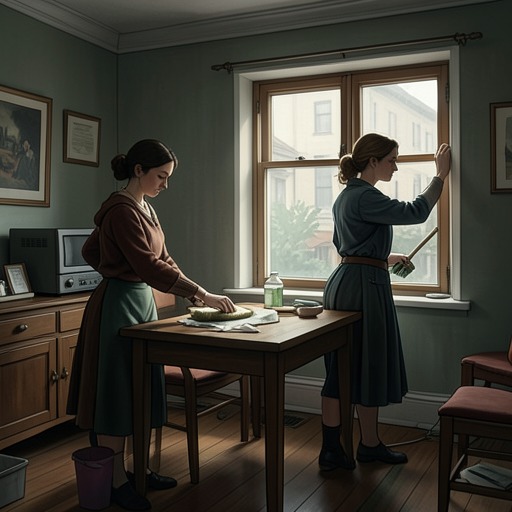
The house’s domestic calendar provides another structure for holding time in place. On Mondays, Merricat and Constance clean and restore rooms without disturbing the established arrangement of their mother’s tortoise-shell comb. Constance sometimes tends Uncle Julian’s room, but he dislikes having his belongings moved; she limits herself to washing his medicine glasses and changing his bed. The food cellar, too, makes continuity tangible. Constance adds her own preserves to the rows made by generations of Blackwood women, while the older jars remain untouched under the family rule that eating them would be fatal. Care here means both replenishing the household and preserving a boundary around its inherited past.
Change as a Threat to the Household
The routines do not make Merricat feel secure once change becomes imaginable. On the Sunday after she senses its approach, she tries to keep her three magic words out of her mind even as she insists that she will not forget them. The uneasy weather and Constance’s warning to wear boots on a walk join the broader pattern of signs she interprets as disturbance. Her protective thinking is not abstract: she depends on repeated actions and hidden objects, and the prospect of change makes those assurances feel newly vulnerable.
The sisters’ conversation about leaving reveals how differently they inhabit the same home. Merricat asks whether they will always be together and answers her own question about where they could go by insisting that no place outside is better and that the world is full of terrible people. Constance, by contrast, briefly wonders whether they might leave, then reassures her sister that nothing bad will happen. The exchange holds intimacy and restriction together: their shared life comforts Merricat, but the question of another life can no longer be excluded entirely.
Charles Blackwood’s arrival turns that possibility into conflict. As Merricat wants him to leave, Constance grows cross with her and insists that he is their cousin, invited to visit, and free to go when he chooses. Merricat believes he makes Uncle Julian sicker; Constance argues that he is trying to keep Julian from dwelling on painful memories. The disagreement is more than a dispute about a guest. Charles’s presence tests whether the household’s established arrangements can be altered, and Constance begins to recognize their cost. She says she has been hiding, allowing Uncle Julian to live in the past and Merricat to run wild. Her acknowledgment marks a moment when preserving the old pattern no longer seems, to her, synonymous with care.
Isolation, Pride, and the Meaning of the Castle
The novel makes the sisters’ resistance to change morally complex by connecting it to the Blackwoods’ class consciousness. They know they have regarded the village with snobbery; the persecution they endure can then appear to confirm their sense of being set apart. Exclusion becomes not only an injury but, for some characters, a source of exultation: separation from a conformist community can be taken as a kind of moral distinction and even a private superiority. The house protects the sisters from outsiders, yet their inherited confidence in their own difference helps make that protection feel like a chosen position rather than merely a retreat.
Merricat’s imagined family gathering in the Summerhouse deepens this ambiguity. She pictures her dead parents indulging her, placing her wishes and comfort above ordinary discipline. Uncle Julian has wondered aloud whether Merricat was so completely adored that she never developed a conscience. The fantasy therefore links the desire to preserve an ideal family arrangement with the possibility that this arrangement was already troubled: it may recreate an earlier reality as much as revise it. Stasis offers Merricat a world in which she is cherished and protected, but the novel leaves the terms of that protection unsettled.
The Enduring Refuge
At the end, the sisters’ world has contracted yet become more defiantly self-possessed. The villagers repent of their cruelty and begin leaving cooked meals and baked goods at the house’s doorstep. These actual offerings echo Merricat’s imagined feast in the Summerhouse, but the difference matters: the food is now provided by the outside world, which has, in effect, accepted the sisters’ claims to their own domain. The shrinking household receives a crown-like confirmation of its separateness.
That outcome makes the sisters’ stasis both victory and limitation. The castle becomes a more exact model of their shared, enclosed self as threatening elements are purged; at the same time, its safety depends on the continuing exclusion of change. The villagers’ gifts do not restore ordinary social life or open the home to them. Instead, they sustain a secluded order in which the sisters can remain together. Stasis is thus not simple immobility: it is an achieved arrangement, maintained through ritual, guarded boundaries, and the transformation of isolation into a form of sovereignty.